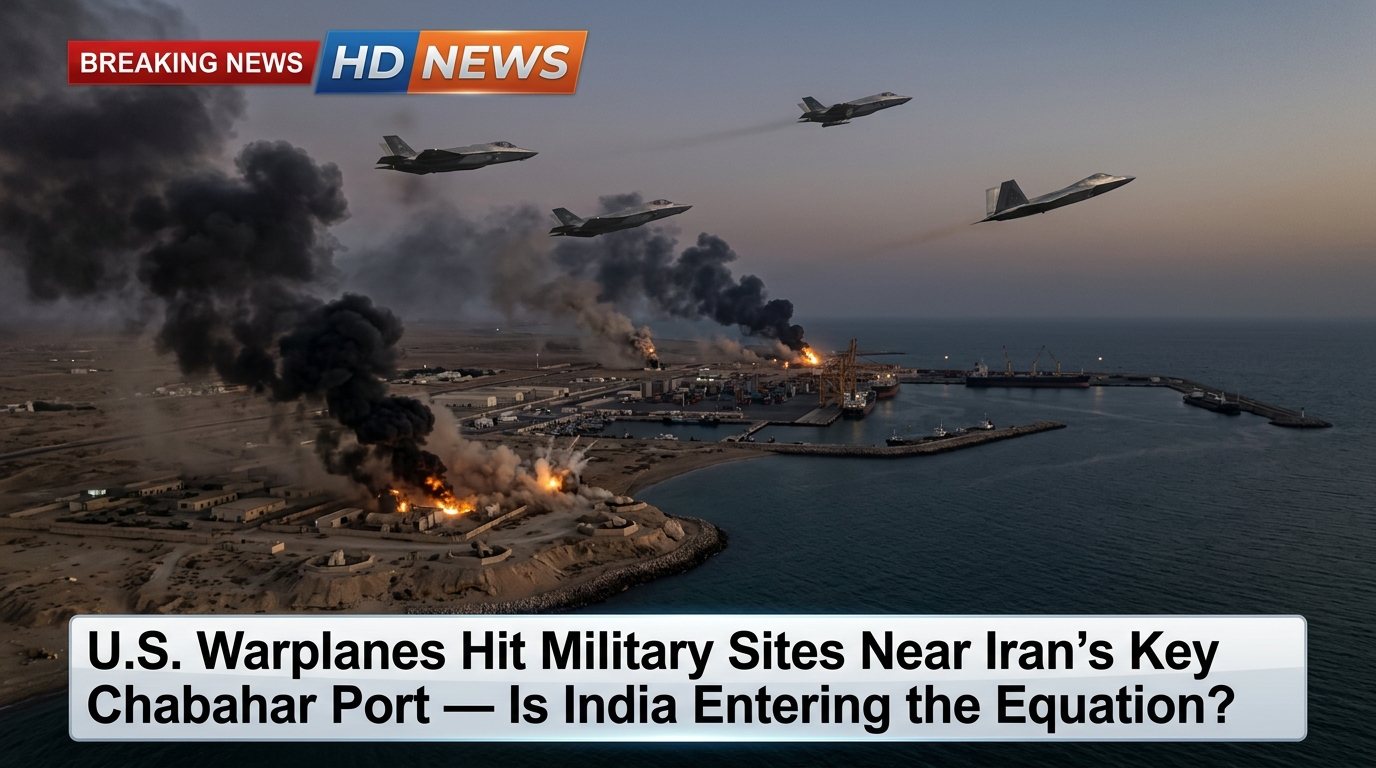
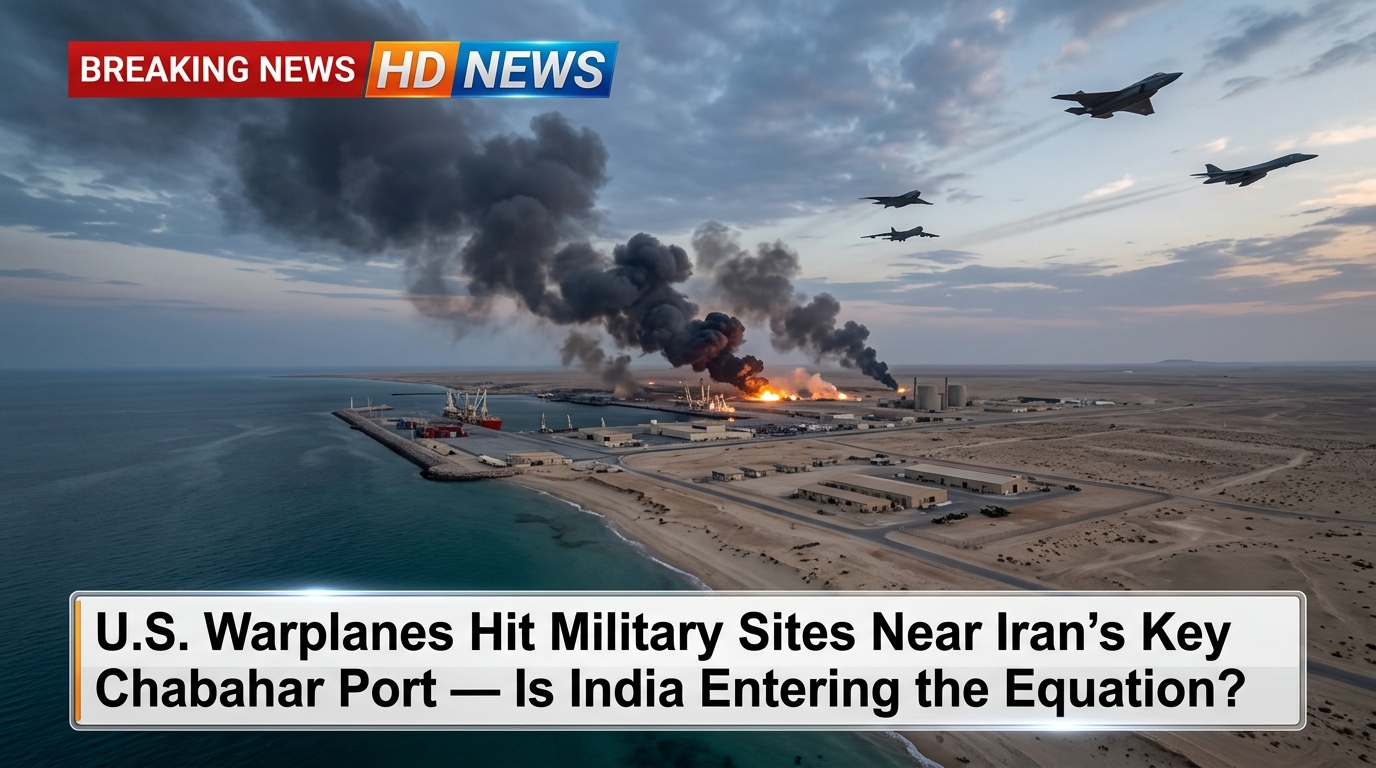
Fresh tensions have erupted in the Middle East after U.S. warplanes reportedly carried out precision strikes on military installations near Iran’s strategically vital port city of Chabahar. The development has not only intensified the ongoing conflict with Tehran but has also sparked urgent questions about whether India—deeply invested in the region—could be drawn into the geopolitical equation.
According to reports, U.S. fighter jets targeted military facilities located near the Chabahar Free Trade Zone, a region of both military and economic importance. The strikes are believed to have focused on defense-related infrastructure rather than civilian or commercial assets, suggesting a calibrated attempt to apply pressure without triggering broader economic fallout.
However, what makes Chabahar uniquely sensitive is its strategic role in India’s foreign policy. The port, developed with significant Indian investment, serves as a critical gateway for New Delhi to access Afghanistan and Central Asia—bypassing Pakistan entirely. This makes any military activity in the area far more than a localized घटना; it directly touches on India’s long-term economic and geopolitical ambitions.
For years, India has walked a delicate line between maintaining strong ties with the United States and preserving its strategic interests in Iran. Even amid rising tensions and U.S. sanctions, New Delhi has repeatedly signaled that withdrawing from Chabahar is “not an option,” emphasizing its importance as a regional connectivity hub.
The latest strikes now complicate that balancing act. While India has officially maintained a neutral stance in the broader U.S.-Iran conflict, calling for de-escalation and dialogue, the proximity of military action to its key infrastructure raises concerns about potential risks to personnel, investments, and future operations.
Analysts suggest that India is unlikely to enter the conflict militarily. Instead, its involvement—if any—would likely remain diplomatic and strategic. New Delhi may intensify backchannel discussions with Washington to secure protections for its assets while simultaneously engaging Tehran to ensure continued cooperation.
At the same time, the situation underscores a broader الحقيقة: global conflicts are increasingly interconnected. A targeted airstrike near Chabahar is not just about U.S.-Iran tensions—it reverberates across trade routes, energy markets, and strategic alliances stretching from the Gulf to South Asia.
For the United States, the strikes signal continued military pressure on Iran without directly targeting economic lifelines. For Iran, they represent yet another фронт in a widening confrontation. But for India, the stakes are uniquely complex—caught between competing powers while trying to safeguard its own strategic foothold.
Ultimately, whether India “enters the equation” will depend not on a single strike, but on how the situation evolves in the coming weeks. If the conflict expands further into economically sensitive zones, New Delhi may find itself forced to take a more visible role—if not militarily, then certainly diplomatically—in shaping the outcome.