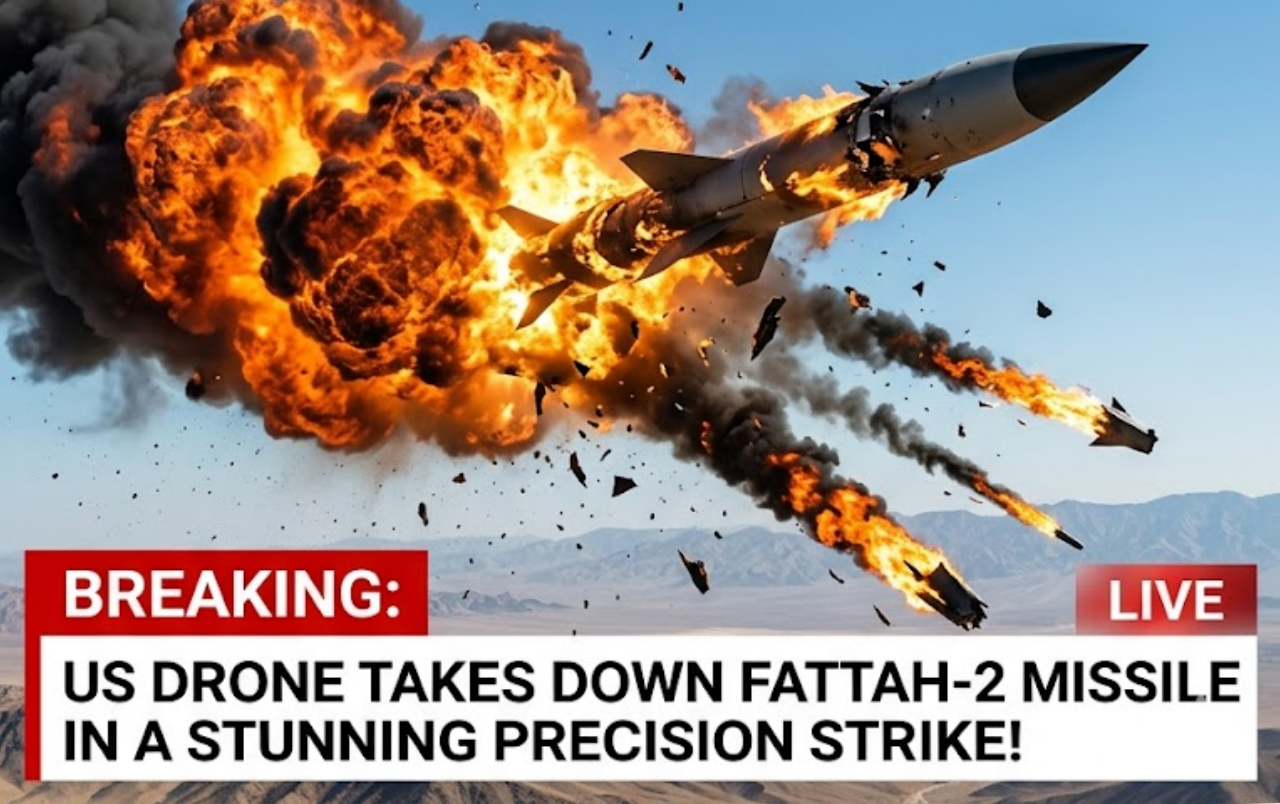
In a remarkable display of modern military technology, a U.S. drone has successfully intercepted and destroyed a Fattah-2 missile in what officials are calling a precision strike of unprecedented accuracy. The operation, carried out earlier today over contested airspace in the Middle East, underscores the growing reliance on unmanned systems to neutralize high-value threats without putting pilots or ground troops at direct risk.
The Fattah-2, an advanced ballistic missile reportedly developed by Iran, has been a source of concern for both U.S. and allied forces due to its potential to target critical military and civilian infrastructure across the region. The missile was detected mid-flight by American intelligence assets, which then coordinated with a high-altitude drone equipped with state-of-the-art sensors and guided munitions to intercept the weapon before it could reach its intended target.
According to sources familiar with the operation, the drone executed a rapid, high-precision maneuver, locking onto the missile in seconds. The strike resulted in a complete annihilation of the Fattah-2 mid-air, leaving no debris capable of reaching the ground. “This is a textbook example of the precision and lethality modern unmanned systems bring to the battlefield,” said one defense analyst. “Intercepting a missile traveling at supersonic speeds is no small feat, and this operation demonstrates the capability of U.S. forces to neutralize high-threat targets remotely.”
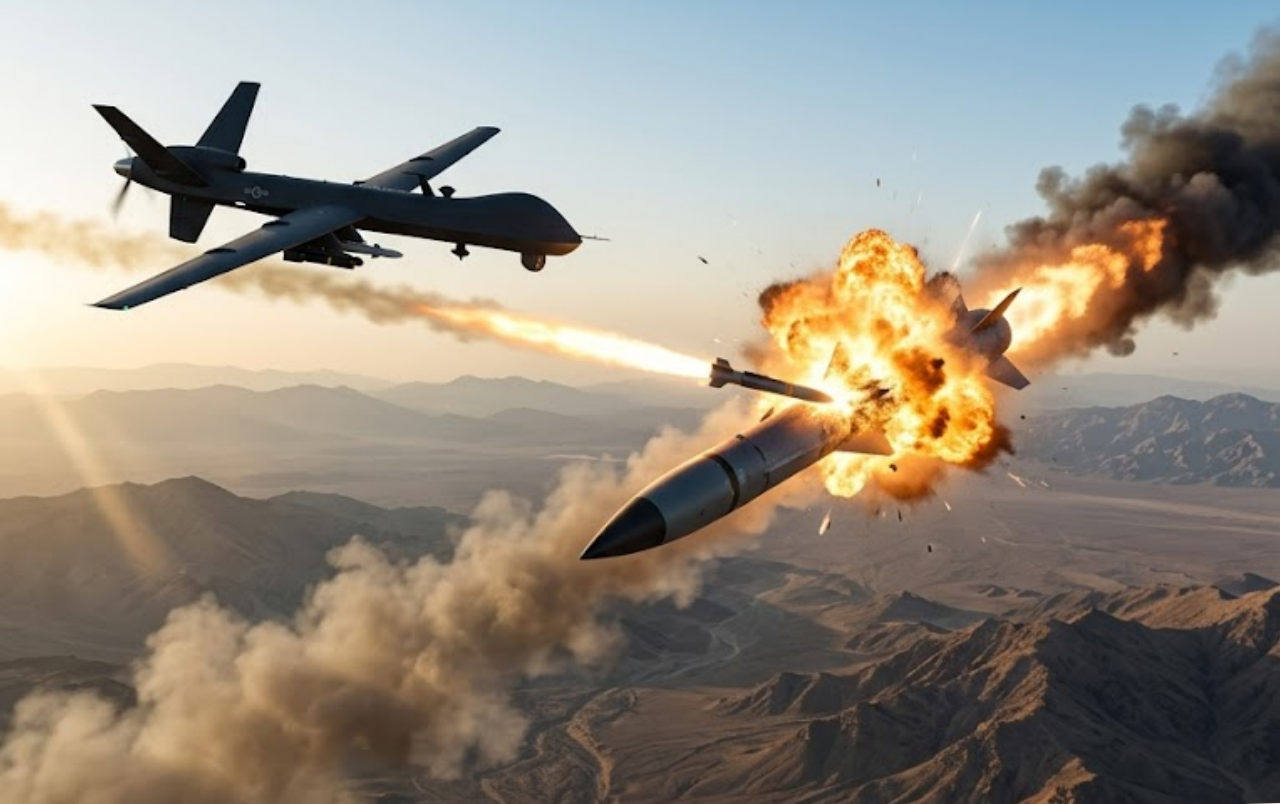
Eyewitnesses in nearby regions reported seeing a bright flash in the sky followed by a loud sonic boom, consistent with a high-velocity intercept. Early satellite images confirm that the missile disintegrated before reaching its intended trajectory, averting what could have been a devastating strike against strategic targets.
The operation carries both tactical and strategic implications. On the tactical level, the success showcases the effectiveness of integrated U.S. drone and missile defense systems, which are capable of responding to fast-moving threats in real time. Strategically, it sends a clear message to Iran and other regional actors that the United States has the capability to preemptively neutralize emerging threats with minimal collateral risk, effectively raising the stakes in ongoing regional tensions.
While U.S. officials have lauded the strike as a decisive success, Iranian state media has denounced it as an act of aggression and vowed to continue missile testing programs. Analysts predict that Tehran may attempt alternative strategies, such as dispersed missile launches or underground storage, to mitigate the threat posed by U.S. drone capabilities.
Experts emphasize that this incident could mark a turning point in modern warfare, where unmanned systems increasingly dominate the battlefield and human operators can engage high-value targets with surgical precision from thousands of miles away. The destruction of the Fattah-2 not only eliminates an immediate threat but also demonstrates the evolving technological advantage of U.S. forces in high-stakes regional conflicts.
As tensions in the region continue to simmer, this strike is likely to be remembered as a benchmark in drone-based missile defense operations, highlighting the remarkable precision, speed, and lethality that modern unmanned systems bring to contemporary combat scenarios.