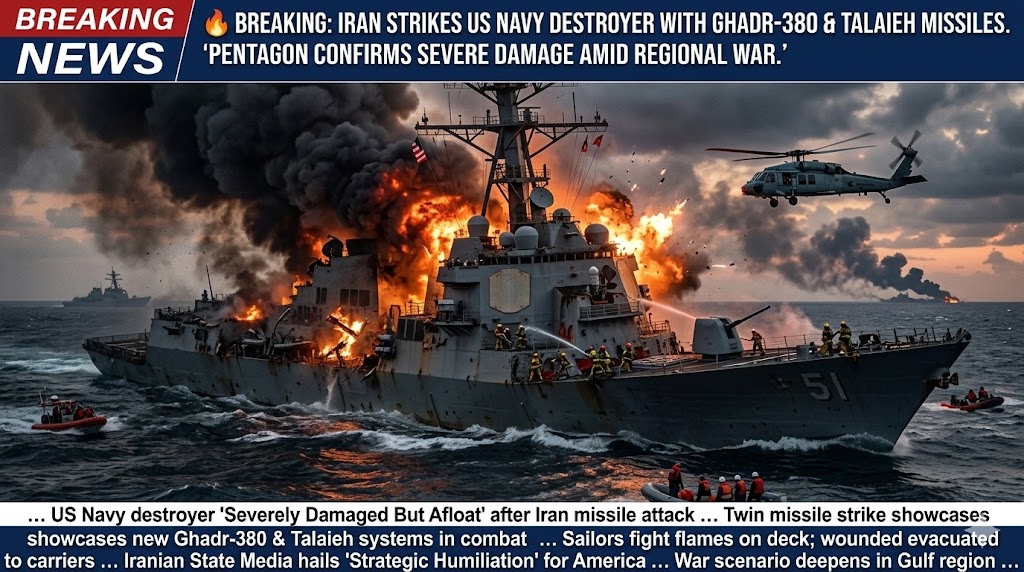
Tensions between the United States and Iran have intensified following a dramatic new development at sea. Iran’s Islamic Revolutionary Guard Corps (IRGC) has announced that it carried out a missile strike against a U.S. Navy destroyer in the Indian Ocean. According to Tehran, the attack involved a combination of Ghadr-380 medium-range ballistic missiles and Talaieh cruise missiles—two systems Iran considers central to its long-range strike capabilities. Iranian officials have portrayed the incident as a significant strategic success, though independent verification remains unclear.
Iranian sources claim the target was located far from its shores, reportedly over 600 kilometers away, at a time when the American vessel was refueling from a tanker in open waters. This detail is particularly notable, as such operations are typically conducted in areas considered relatively secure. The Ghadr-380 missile is believed to offer high-precision targeting over extended distances, while the Talaieh cruise missile is designed to adjust its trajectory mid-flight, allowing it to engage moving targets more effectively.
Reports from Iranian state media suggest that the strike caused serious damage. Officials described extensive fires breaking out on both the destroyer and its support vessel following the missile impact. If accurate, this would represent an unusual and potentially significant event, as direct hits on major naval assets in this region are rarely confirmed. However, these claims have not been independently corroborated, and such reports often remain difficult to verify in real time due to the nature of ongoing military tensions.
Tehran has framed the operation as part of a broader regional strategy known as “Operation True Promise 4.” This campaign is presented as a response to continued military pressure from both the United States and Israel across West Asia. Iranian leaders have repeatedly emphasized that their missile forces are capable of reaching distant maritime targets, challenging long-standing assumptions that U.S. naval vessels are relatively safe when operating far from Iranian territorial waters.
On the other hand, U.S. officials have not confirmed any loss or serious damage to a destroyer. While Iran has released images and video footage that it claims support its account, American military sources have not validated these materials. This divergence highlights a common feature of modern conflicts, where competing narratives emerge quickly, and definitive confirmation can lag behind initial reports. Information warfare, alongside conventional military operations, plays a growing role in shaping perceptions of such घटनाओं.
If Iran’s claims were to be substantiated, the implications would be considerable. Successfully striking a U.S. warship at such a distance would mark a notable shift in naval engagement dynamics, demonstrating an expanded reach of missile technology and raising questions about the vulnerability of high-value maritime assets. It could also signal a new phase of escalation, where long-range precision strikes at sea become a more prominent feature of regional confrontations.
Even without confirmation, the mere assertion of such an attack is likely to have consequences. It may increase tensions in an already volatile region, influence military planning on both sides, and contribute to uncertainty in global security environments. Markets tied to energy and shipping routes could also react, given the strategic importance of maritime stability in the Indian Ocean and surrounding areas.
In essence, whether fully verified or not, the incident underscores how quickly regional disputes can intensify and how advancements in missile capabilities are reshaping the balance of power at sea.