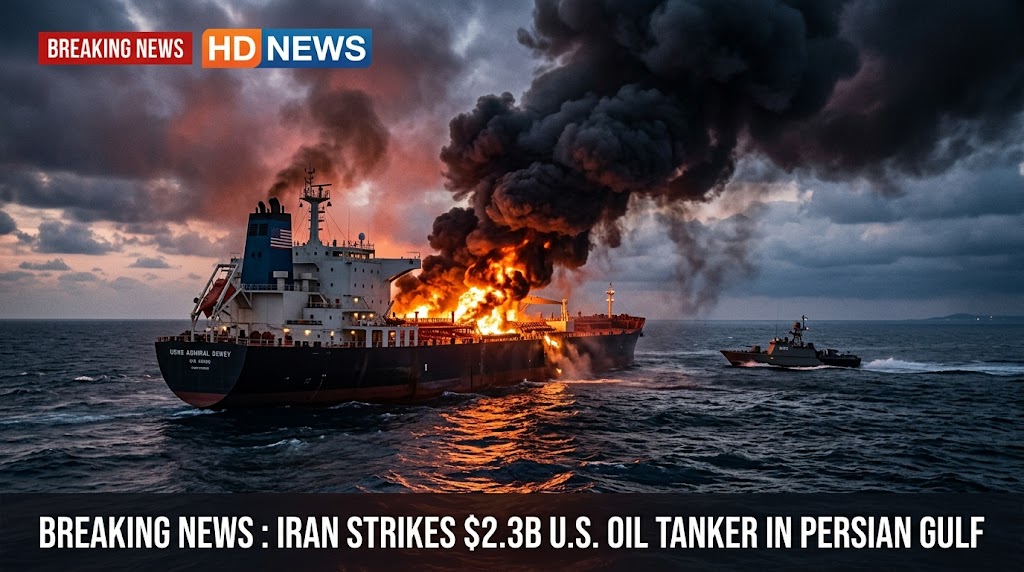
Global financial markets and defense communities have been shaken by new reports indicating that Iran has allegedly struck a U.S.-associated oil tanker in the Persian Gulf. The vessel, estimated to be worth around $2.3 billion, was targeted in what is being described as one of the most consequential maritime incidents tied to the current regional tensions.
According to early accounts, Iran’s Islamic Revolutionary Guard Corps carried out a coordinated operation against the supertanker while it was passing through one of the Gulf’s busiest shipping corridors. While full details are still being confirmed, widely shared footage online appears to show the ship heavily damaged, with thick smoke and flames rising from its structure after the impact. The visuals have intensified concerns about the safety of commercial navigation in one of the world’s most strategically vital waterways.
This event unfolds against the backdrop of escalating tensions surrounding the Strait of Hormuz, a narrow but crucial passage through which a significant portion of the world’s oil supply flows. In recent weeks, Iran has increasingly asserted control over this maritime route, effectively limiting ship movement and issuing repeated warnings toward vessels connected to the United States and its allies. As a result, tanker traffic has slowed dramatically, creating ripple effects across global energy supply chains.
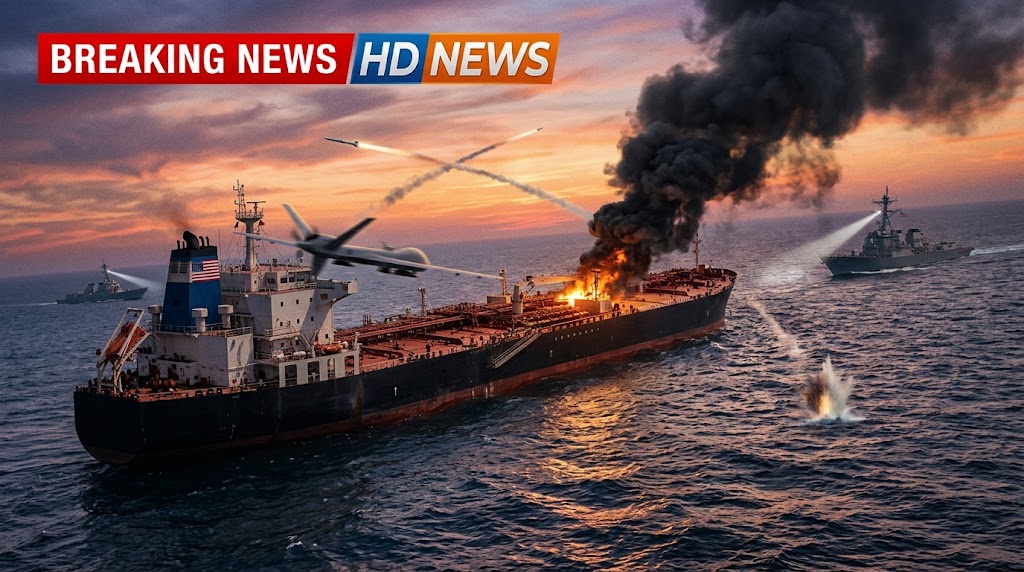
The United States is now reportedly reviewing its options in response to the attack. Military and diplomatic officials are assessing possible courses of action, with strong indications that Washington does not intend to let such incidents go unanswered. Defense authorities have emphasized that assaults on commercial shipping and energy infrastructure are viewed as serious provocations. Potential responses could include intensified naval patrols in the region, rapid deployment of defensive assets, and even targeted retaliatory measures aimed at deterring further aggression. Ensuring freedom of navigation remains a central priority for U.S. strategy in the Gulf.
Even before any formal response is announced, the global oil market has already begun reacting. The ongoing instability in the Strait of Hormuz has contributed to sharp increases in oil prices, driven by fears of supply disruptions. With fewer tankers able or willing to pass through the region, concerns about shortages have pushed prices upward, affecting economies far beyond the Middle East. Energy-importing nations, in particular, are closely monitoring developments, as prolonged disruptions could have lasting economic consequences.
The attack also signals a broader shift in the nature of the conflict. What was once largely characterized by indirect confrontations and missile exchanges is now extending into direct strikes on commercial assets. This escalation significantly raises the stakes, as civilian shipping and global trade routes become increasingly exposed to risk. For industries such as maritime transport and insurance, the situation is becoming more complex and uncertain. Companies are being forced to reevaluate their operations, reassess risk exposure, and potentially reroute shipments to avoid dangerous zones.
Governments around the world are also paying close attention, recognizing that instability in the Persian Gulf has far-reaching implications. The region is not only a geopolitical flashpoint but also a cornerstone of global energy security. Any sustained disruption could reshape trade patterns, increase transportation costs, and heighten geopolitical rivalries.
In summary, the reported attack on the tanker represents more than a single incident; it reflects a deepening crisis with global ramifications. As tensions continue to rise, the coming days will be critical in determining whether the situation stabilizes or escalates further into a broader confrontation.