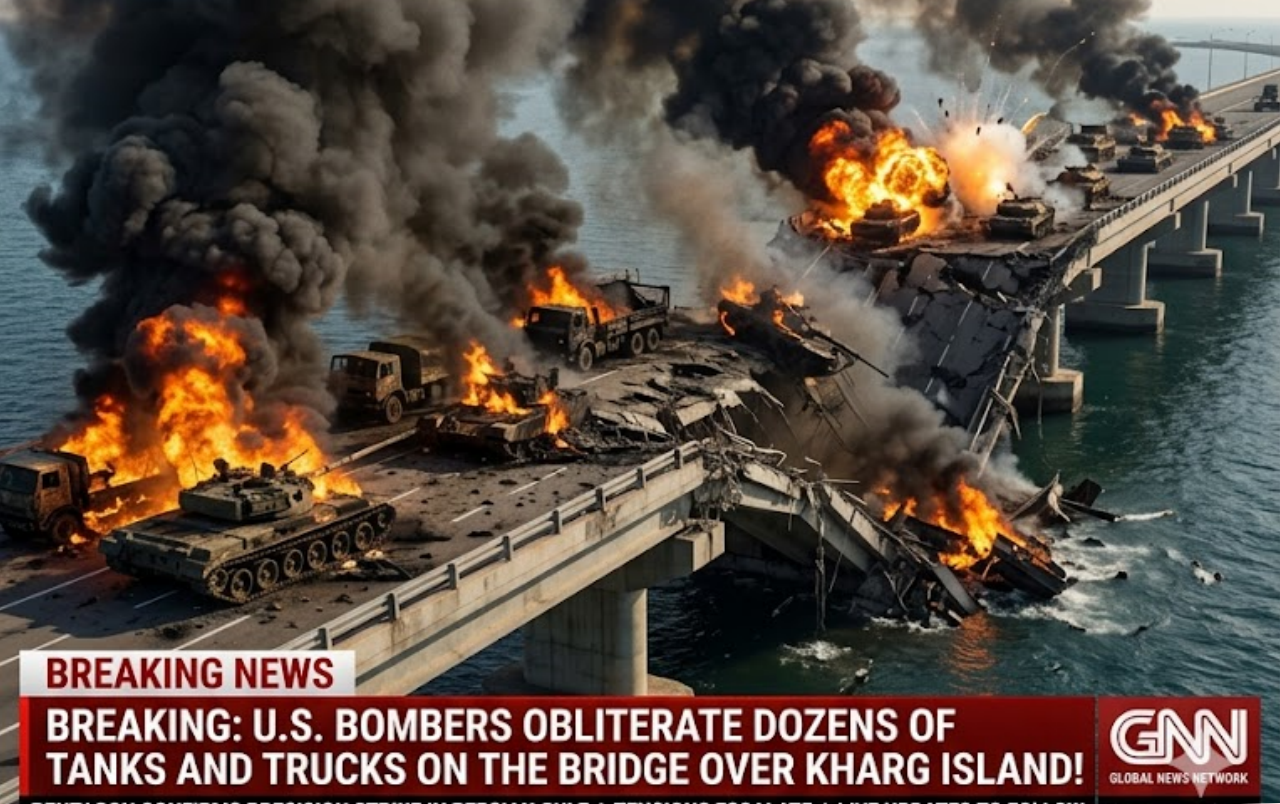
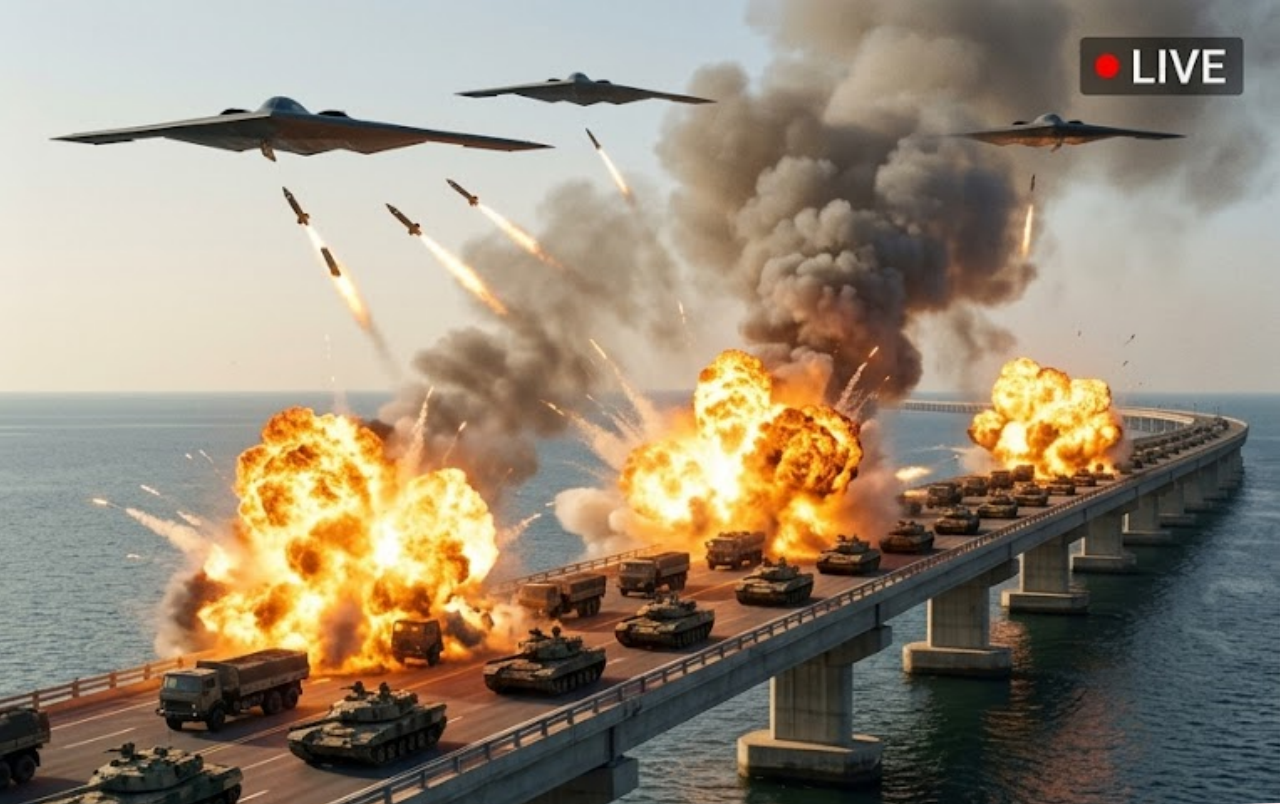
In one of the boldest moves of the 2026 Middle East conflict, U.S. military aircraft have reportedly unleashed a devastating precision bombing strike that obliterated dozens of Iranian tanks and troop transport trucks on a strategically crucial bridge approaching Kharg Island, the nation’s primary oil export hub. This strike marks an intensified chapter in the ongoing confrontation as Washington pushes to degrade Tehran’s military capabilities and secure crucial waterways like the Strait of Hormuz.
The bridge — a vital artery connecting Kharg Island’s military installations to the Iranian mainland — became the focal point of the strike, as U.S. planners identified it as a chokepoint through which armored reinforcements and logistics convoys were moving. Utilizing long-range precision‑guided munitions launched from strategic bombers, U.S. forces reportedly landed multiple direct hits on Iranian armored columns congregated on the structure, reducing tanks, armored personnel carriers, and support trucks to rubble and flame. While details about Iranian casualties haven’t been independently confirmed, the scale of destruction described in initial reports has sent shockwaves through military and geopolitical circles.
This operation followed a series of major strikes on Kharg Island earlier in March 2026, when U.S. aircraft targeted more than 90 military sites on the island, including missile storage bunkers and naval mine depots, as part of a broader effort to degrade Iran’s control over the Gulf and ease pressure on international trade routes. U.S. leaders emphasized these earlier strikes focused on military targets while deliberately sparing the island’s oil infrastructure — which handles an overwhelming majority of Tehran’s crude exports — in hopes of limiting broader economic fallout.
For Iran, the intensified attacks on Kharg Island’s approaches represent a significant escalation. Iranian state media and officials have strongly condemned the strikes, reiterating threats to retaliate against foreign energy assets if their own oil infrastructure is targeted. The island’s oil terminals and export capacity are central to Iran’s economy; even indirect damage or disruption to export operations could ripple across global energy markets, already strained by the ongoing conflict.
Analysts note that U.S. precision strikes on armored and logistical forces approaching strategic targets like Kharg Island reflect a shift toward open battlefield interdiction and attempts to blunt Iranian force mobility. Destroying large concentrations of armor on key terrain — such as critical bridges — not only inflicts direct material losses but also complicates Tehran’s ability to reinforce forward positions, defend coastal assets, or contest naval movement in the Gulf.
The geopolitical stakes are immense. Kharg Island lies at the heart of Iran’s oil export network and is a linchpin in controlling access to the Strait of Hormuz, through which roughly one‑fifth of the world’s crude oil normally transits. Any sustained disruption to Iran’s military ability to defend this hub — or further damage to its energy infrastructure — could drive up global oil prices and increase tensions among major powers with interests in Middle Eastern stability.
While independent global media have not yet verified every specific detail of the tank and truck destruction on the bridge, the broad pattern of escalating U.S. strikes on Kharg Island’s military infrastructure is confirmed by multiple reputable sources.
In short, this latest strike highlights the dramatic transformation of the conflict from limited air engagements to high‑impact precision attacks on ground forces — signaling that the battle for strategic control in the Gulf is entering an increasingly kinetic phase.