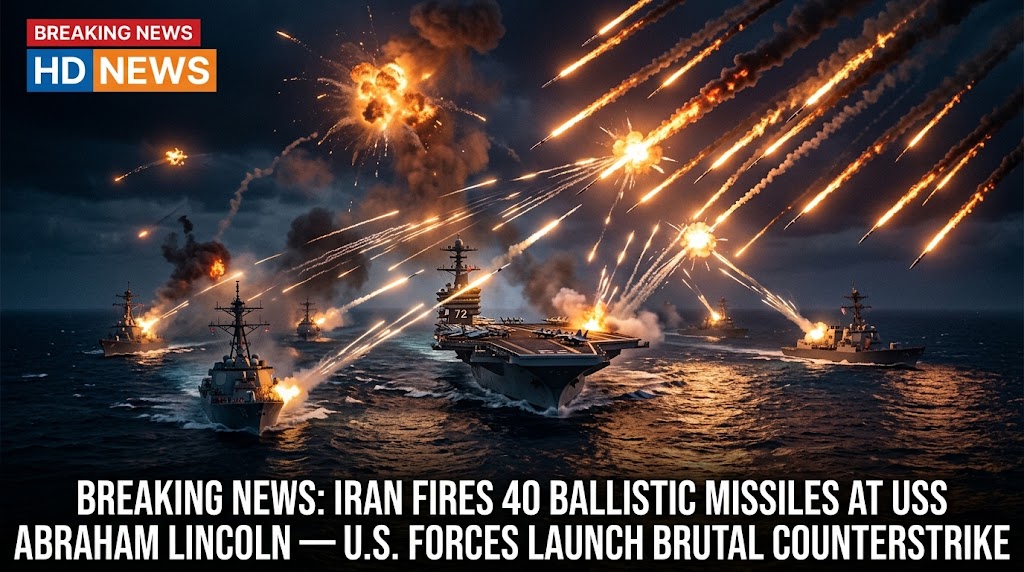
Tensions across the Middle East have intensified dramatically following Iran’s announcement that it launched a large-scale missile attack targeting the U.S. aircraft carrier USS Abraham Lincoln. The claim has heightened concerns in an already volatile region and prompted a swift reaction from American forces stationed nearby.
According to Iranian military officials, the strike involved multiple missiles, including cruise missiles, aimed at the carrier strike group. State-affiliated media outlets broadcast footage purportedly showing missiles being launched in the direction of the U.S. naval formation. Iranian authorities framed the operation as a retaliatory measure, citing recent U.S. and Israeli military actions within Iranian territory as justification. This narrative positions the strike as part of a broader pattern of response rather than an isolated escalation.
However, the United States has strongly disputed Iran’s claims. U.S. Central Command reported that although missiles may have been launched, none came close to striking the USS Abraham Lincoln or its accompanying vessels. American officials emphasized that the carrier remains fully functional and has sustained no damage. This stark contrast in accounts highlights the difficulty of verifying events in real time, especially in a highly contested information environment.
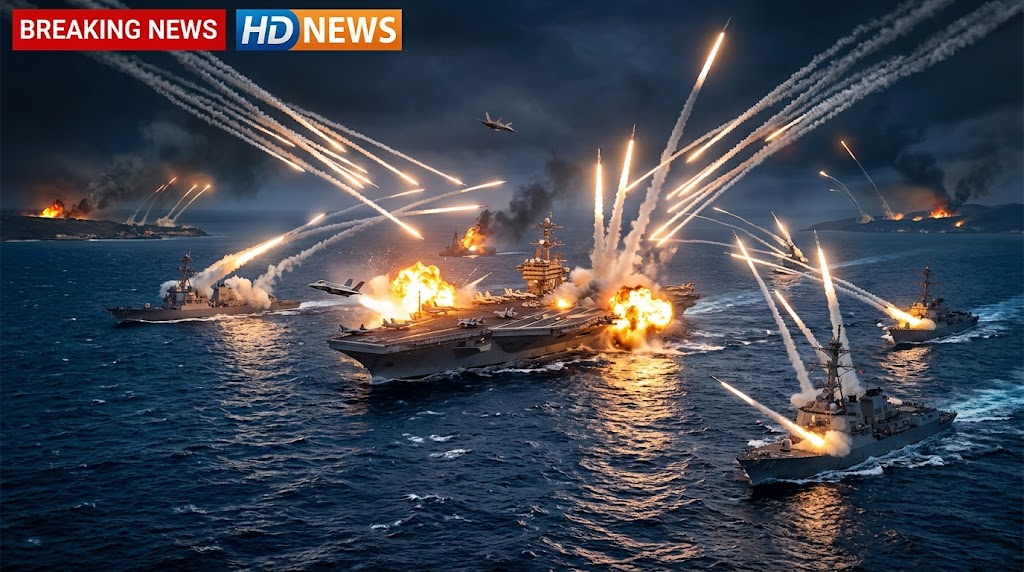
In response to the reported missile barrage, U.S. forces acted quickly. Naval and air units carried out counterstrikes targeting locations believed to be linked to missile launches and Iranian military infrastructure. While detailed information about the operation has not been publicly disclosed, defense sources describe the response as precise and forceful. The objective, according to these sources, was to weaken Iran’s capacity to conduct further missile attacks and to demonstrate the readiness of U.S. forces to defend their assets.
This latest exchange is part of a broader escalation that has been unfolding over recent weeks. The region has seen a surge in military activity, including frequent airstrikes, missile launches, drone operations, and naval maneuvers. Such developments have transformed the Middle East into a highly active conflict zone, where multiple actors are engaged in overlapping confrontations. The alleged targeting of the USS Abraham Lincoln underscores the symbolic and strategic importance of aircraft carriers, which often serve as both operational hubs and visible representations of military power.
Beyond the immediate military implications, the incident raises significant strategic concerns. Both Iran and the United States have accused each other of provoking further escalation, creating a cycle of action and retaliation. Without independent verification of key claims—particularly regarding whether the carrier was ever in real danger—the situation remains clouded by uncertainty. This lack of clarity increases the risk of miscalculation, where decisions based on incomplete or contested information could lead to unintended consequences.
Moreover, the episode illustrates how quickly tensions can spiral in a region already burdened by complex geopolitical rivalries. Even a single incident, whether fully confirmed or not, can trigger a chain reaction of military responses. At the same time, it highlights the dual role of major naval assets: they are not only crucial for operational purposes but also serve as high-value targets that can escalate conflicts when threatened.
As the situation continues to develop, international observers are watching closely. The key question is whether this confrontation will lead to further military escalation or encourage renewed diplomatic efforts to ease tensions. Given the current trajectory, both outcomes remain possible. What is clear, however, is that the region stands at a critical juncture, where decisions made in the coming days could significantly shape the course of the conflict.