
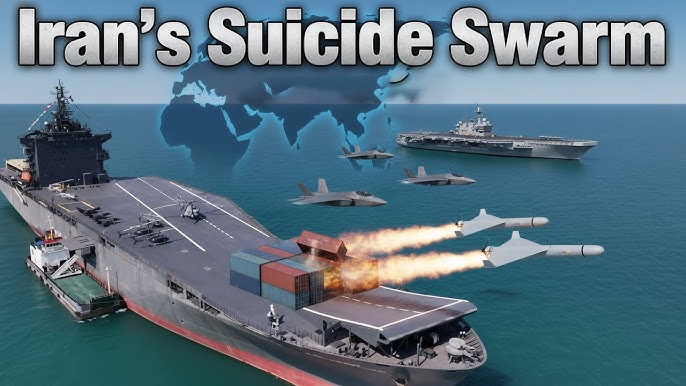
At first, it looked like something out of the future.
Dozens of drones lifting off from a single vessel—spreading across the sky, forming a moving شبكة of surveillance and potential attack power. Iran’s so-called “drone carrier,” a converted ship capable of launching scores of UAVs, was designed for exactly this moment.
The idea was simple.
Overwhelm.
Outnumber.
Outmaneuver.
But here’s what actually happened.
There is no verified evidence that Iranian drone carriers successfully “swarmed” U.S. Navy fighter jets in a massive aerial battle as described in viral headlines.
What is confirmed, however, is still highly significant.
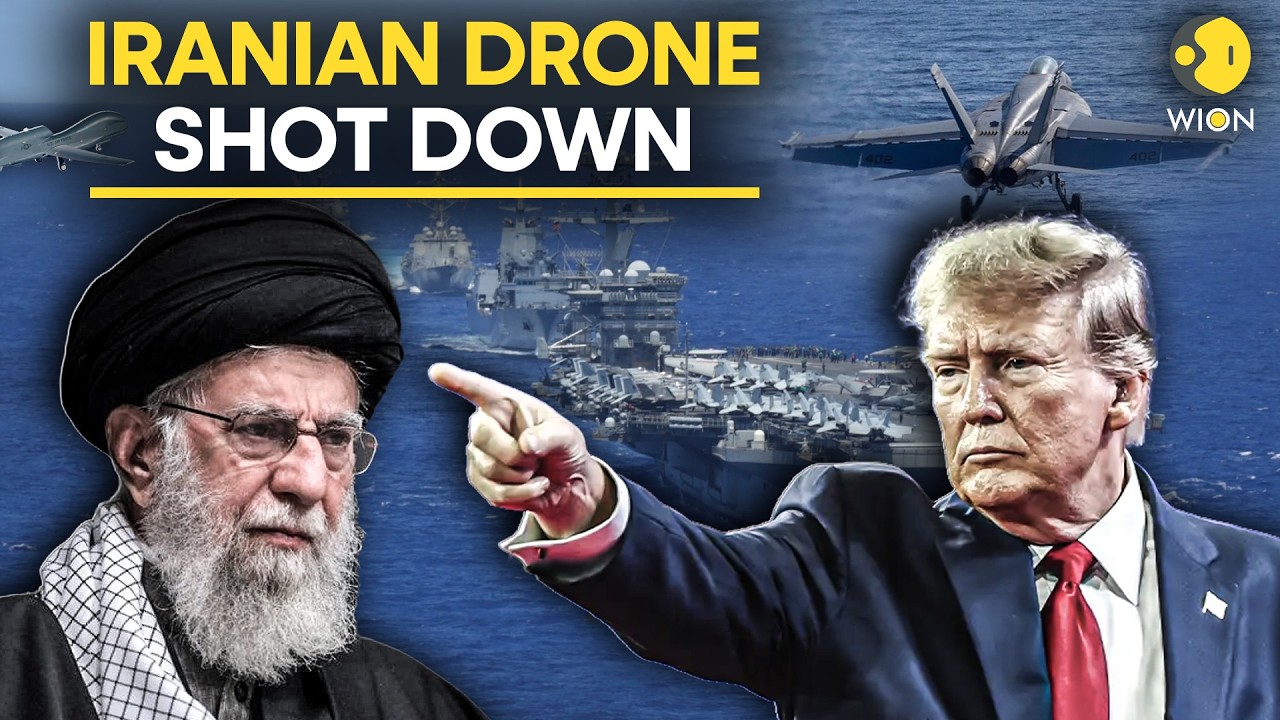
Iran has deployed drones aggressively around U.S. naval forces—and those encounters have already turned dangerous. In one real incident, an Iranian drone flew toward the USS Abraham Lincoln, forcing a response. A U.S. Navy F-35 fighter jet intercepted and shot the drone down before it could reach the carrier.
That moment reveals the real dynamic.
Not overwhelming success—but constant pressure.
And there’s more.
Iran’s drone carrier itself—the Shahid Bagheri—became a target. During the conflict, U.S. forces struck and disabled the vessel, dealing a major blow to Iran’s ability to project drone power from the sea.
So instead of swarming U.S. fighters…
The carrier was hit before it could change the balance.
Still, the concept behind the headline is important.
Drone carriers represent a new kind of warfare.
Instead of relying on expensive jets, they deploy:
- Large numbers of low-cost drones
- Surveillance swarms
- Potential kamikaze strikes
In theory, such a swarm could:
- Distract advanced fighters
- Force expensive missile interceptions
- Create confusion in contested airspace
But in reality, U.S. naval aviation still holds a major advantage.
Aircraft like the F-35 are built for exactly this kind of environment:
- Advanced radar and sensors detect threats early
- Long-range weapons eliminate targets before they get close
- Electronic warfare systems disrupt drone coordination
That’s why, so far, encounters have ended the same way:
Drones approach.
Fighters respond.
Threats are neutralized.
Still, the threat is evolving.
Iran continues to invest heavily in drone warfare, and swarm tactics remain one of the few ways to challenge technologically superior forces. And while current attempts have been limited or unsuccessful…
The concept isn’t going away.
Because in modern war, it’s not always about one powerful weapon.
It’s about numbers.
And if a swarm ever gets through—just once—it could change everything.
For now, though, the skies still belong to the side that sees first… and shoots first.
And in this battle, that edge still belongs to the U.S. Navy.