
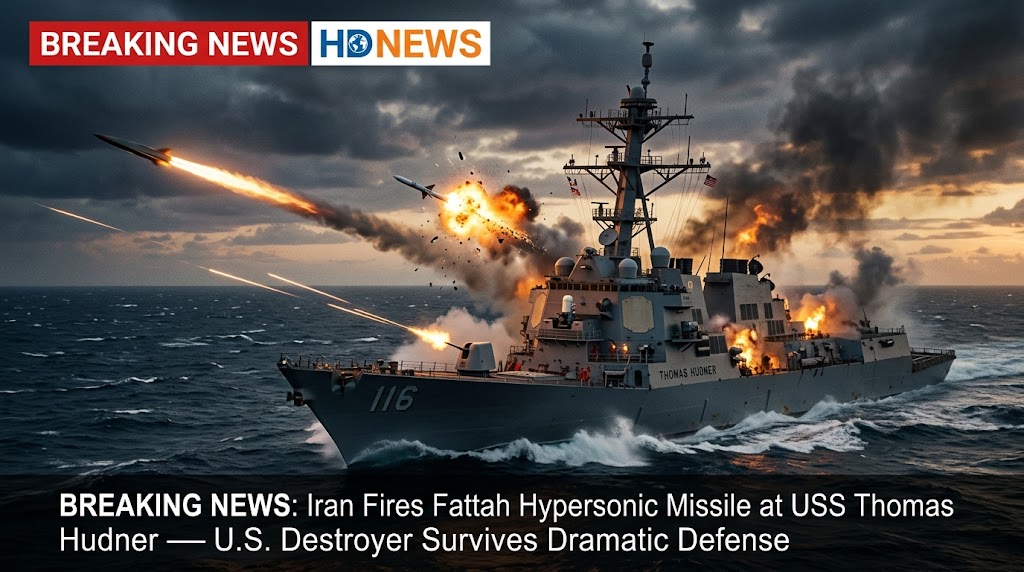
Amid rising tensions at sea, new reports suggest a potentially serious confrontation involving Iran and a U.S. naval vessel. According to circulating accounts, Iran may have launched a hypersonic Fattah-class missile targeting the USS Thomas Hudner (DDG-116), a U.S. Navy destroyer, triggering a high-stakes defensive response.
Unconfirmed information from social media sources and eyewitness claims indicates that Iranian forces deployed a Fattah hypersonic ballistic missile during a period of heightened regional strain. This class of missile, which Iran has promoted in recent years, is designed to travel at extremely high speeds while maintaining the ability to maneuver mid-flight. Such capabilities make it significantly more difficult for traditional missile defense systems to track and intercept. If these reports are accurate, the launch would represent a notable advancement in both the intensity and sophistication of military engagements in the region.
The USS Thomas Hudner, an Arleigh Burke-class guided missile destroyer, is equipped with advanced, layered defense systems capable of detecting and responding to incoming threats. According to the same unverified accounts, the ship identified the missile in time and activated its interception protocols. Although official confirmation from the U.S. military has not yet been released, early descriptions suggest the vessel was able to successfully counter the threat, either by intercepting the missile or evading it without sustaining major damage. This highlights the effectiveness of modern naval defense technologies, particularly when facing emerging high-speed weapons.
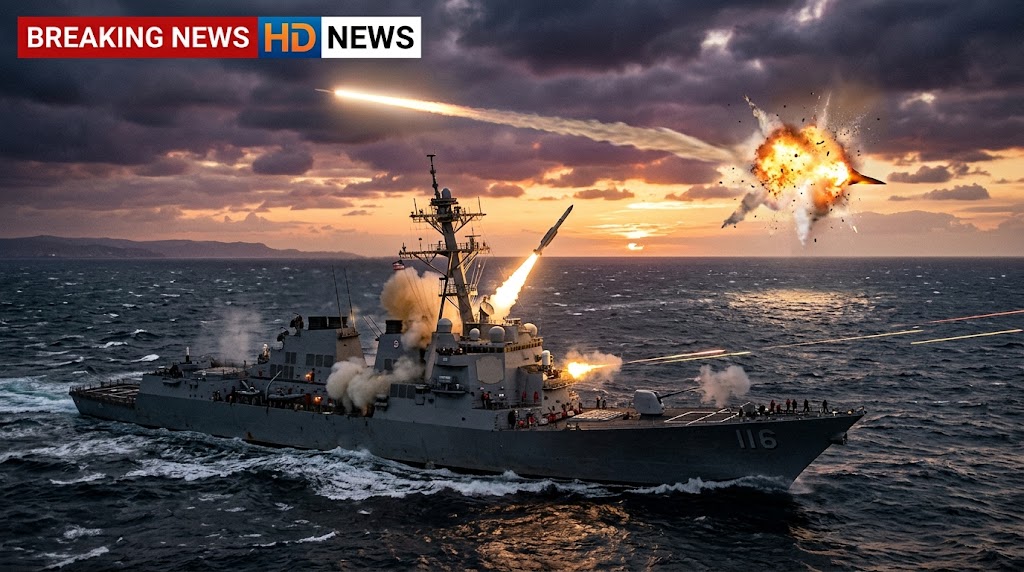
The Fattah missile itself has been presented by Iran as a major step forward in its missile program. The Fattah-1 variant is described as a medium-range ballistic missile capable of reaching speeds between Mach 13 and Mach 15. Its reported maneuverability allows it to alter its trajectory during flight, complicating interception efforts. Iran has also introduced a newer version, the Fattah-2, which is said to incorporate further technological improvements. However, many defense analysts remain cautious, noting that real-world performance and operational reliability of these systems are still uncertain and may not fully match official claims.
This incident, whether fully verified or not, reflects a broader trend of increasing complexity in naval and missile warfare, particularly in the Middle East. The region has long been a focal point of geopolitical tension, and recent developments suggest that both state and non-state actors are investing heavily in advanced weapons systems. The presence of the USS Thomas Hudner in these waters is part of ongoing U.S. efforts to ensure maritime security and deter potential threats. The ship has previously been involved in operations to counter drones and missiles, demonstrating the evolving nature of modern naval missions.
What makes this situation particularly concerning is the potential shift toward the use of hypersonic weapons in active conflict scenarios. Unlike traditional missiles, hypersonic systems travel at speeds that significantly reduce reaction time for defensive systems, while their maneuverability makes them harder to predict and intercept. This combination poses a serious challenge for even the most advanced naval defenses and could force military forces worldwide to rethink their strategies and technologies.
If confirmed, the attempted use of a hypersonic missile against a U.S. warship would mark a notable escalation in both capability and intent. It would signal not only a willingness to deploy cutting-edge weapons but also an increased risk of miscalculation in an already volatile environment.
As more information becomes available from official defense sources, analysts and policymakers will be closely monitoring the situation. The key question remains whether this event represents a genuine operational use of hypersonic technology or simply another instance of heightened rhetoric and unverified claims amid ongoing tensions. Either way, the implications for future naval warfare are significant and cannot be ignored.